
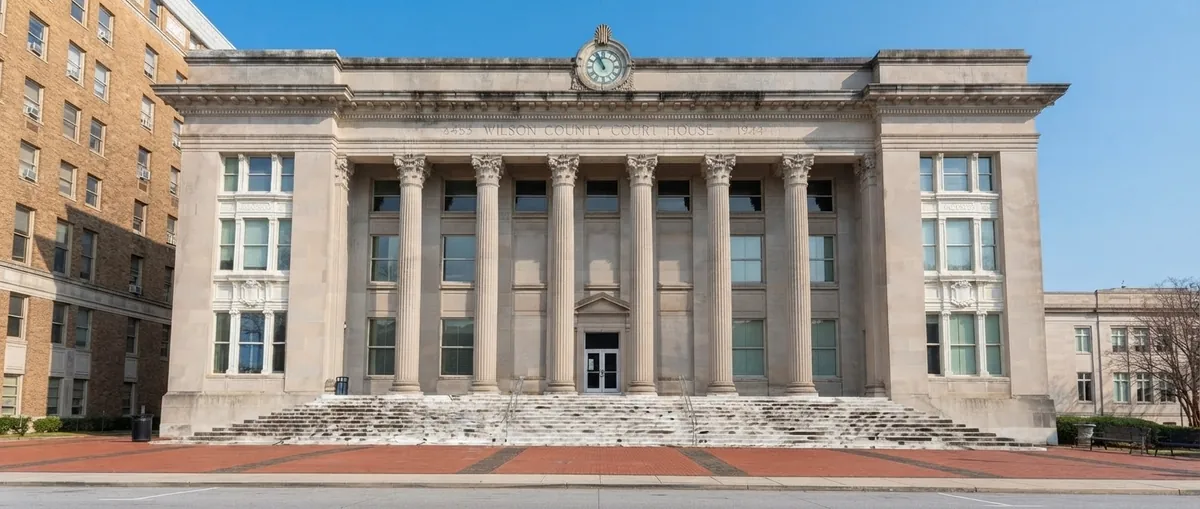
Court records of Wilson County, North Carolina, are maintained by the Clerk of Superior Court's office and are accessible through online tools, official court portals, and directly at the office. WilsonNCCourt.us will help you find public information about court records of this county. Additionally, you can use the North Carolina Judicial Branch portal for Wilson County, visit the office in person, or send a request by mail.
Wilson Court System Overview
Wilson County is part of the 7th Judicial District of North Carolina. This district includes Wilson, Edgecombe, and Nash counties. The county courts are divided into Superior Court and District Court, each handling different categories of cases. Magistrates work as a division of the District Court — they issue warrants, conduct initial hearings, and handle small claims.
Wilson County Courthouse is located at:
Office hours: Monday–Friday, 8:00 AM–5:00 PM. For office phone inquiries, refer to the Wilson County page on the NC Judicial Branch website.
Courts Serving Wilson
Residents of Wilson County are served by several courts of different jurisdictional levels:
Wilson County Superior Court
Wilson County District Court
Magistrate Division (District Court)
Magistrates operate at the Wilson County Courthouse and handle small claims, issue warrants, and conduct initial hearings.
U.S. District Court for the Eastern District of North Carolina
Wilson County belongs to the Eastern District of the federal court of North Carolina. Bankruptcy cases are handled by the U.S. Bankruptcy Court for the Eastern District of North Carolina.
Municipal Courts
There are no separate municipal courts in North Carolina. Violations of city ordinances are heard in District Court.
What Types of Cases Wilson Courts Hear
Wilson County courts hear a wide range of cases. Here are the main categories:
- Criminal cases: felonies, misdemeanors, infractions
- Civil cases: claims over $25,000 (Superior Court), claims up to $25,000 (District Court), small claims up to $10,000 (Small Claims — magistrate)
- Family law: divorce, custody, alimony, protective orders
- Probate: inheritance, guardianship, conservatorship
- Juvenile cases: offenses, child protection, adoption
- Traffic violations and DWI
District Court Cases in Wilson
The District Court in Wilson County handles misdemeanors, traffic violations, family law cases, and civil claims up to $25,000. Additionally, juvenile and child protection cases are heard here. The presiding judge is a District Court Judge appointed within the 7th Judicial District.
The Superior Court takes on felonies after a preliminary hearing in District Court, as well as civil cases over $25,000 and appeals from District Court decisions. Cases are assigned to judges according to a calendar approved by the district's administrative judge.
Magistrate Court Cases in Wilson
Magistrates are judicial officers at the District Court. In Wilson County, they perform several key functions:
- Handle small claims up to $10,000
- Issue arrest and search warrants
- Set bail
- Conduct initial hearings in criminal cases
- Handle eviction cases
- Perform marriage ceremonies
Under North Carolina law, magistrates do not conduct full trials in misdemeanor cases — these cases are transferred to District Court. If a party is dissatisfied with a magistrate's decision in a small claim, they have the right to a trial de novo in District Court.
Family Law, Probate, and Juvenile Matters in Wilson
Family Law
Divorce, child custody, alimony, paternity, and protective order cases are heard in District Court. A divorce certificate can be obtained from the court office where the case was filed or through NC Vital Records. General information on marriage and divorce documents is also provided by the state's Vital & Public Records portal.
Probate
The Clerk of Superior Court's office in Wilson County handles inheritance, guardianship, and conservatorship cases. Applications are submitted directly to the office. Trust matters usually also go through this division.
Juvenile Matters
Juvenile offenses and child protection cases (Child Protective Services) are heard in District Court. These records are confidential under North Carolina law — access to them is strictly limited.
How Cases Move Through the Wilson Court System
- Case Initiation. A criminal case begins with a complaint or warrant; a civil case starts with a complaint; family or probate cases begin with a petition.
- Judge Assignment. The case is assigned according to the 7th District's court calendar.
- Initial Hearing. In criminal cases, this is an arraignment; in civil cases, it's a scheduling conference.
- Pre-Trial Phase. Parties exchange evidence (discovery), file motions. In criminal cases, plea negotiations may occur.
- Trial. The case concludes with a sentence, settlement, default judgment, or jury verdict.
- Post-Judgment. Sentencing, appeal filing, or judgment enforcement.
Court Administration, Local Rules, and Public Access in Wilson
The courts of the 7th Judicial District are administered by the Senior Resident Superior Court Judge. The Trial Court Administrator coordinates daily operations, including hearing schedules and resource allocation.
Local court rules for this district are published on the NC Judicial Branch website. It is recommended to check the current rules before filing documents.
Public Access to Records
According to Chapter 132 of the General Statutes of North Carolina (Public Records Act), most court documents are publicly accessible. Exceptions include juvenile cases, sealed cases, and records for which the court has issued a specific order restricting access. To request a public record, contact the office in person, by mail, or online.
Attending Hearings
Court sessions in Wilson County are generally open to the public. Some hearings may be conducted remotely — check participation procedures on the Wilson County page or by calling the office.
Court Records and Related Court Resources in Wilson
- Case Search. The NC Judicial Branch portal allows case searches by name, citation number, or county. You can also find hearing dates and make payments here.
- Court Calendar. Wilson County criminal and civil calendars are available online — check the schedule before visiting the court.
- Court Forms and Self-Help Resources. The NC Judicial Branch website offers forms for various types of cases, as well as instructions for self-represented individuals.
- Court Office and Record Requests. To obtain copies of court orders, certificates, or records, use the public records request procedure.
- Convicted Offender Search. The NC Department of Adult Correction provides information on inmates in state facilities, probationers, and parolees.
- Sex Offender Registry. The NC Sex Offender Registry allows searches for registered individuals by address, name, or county.
- Criminal Check and Expungement. Information on obtaining a criminal record check or the expungement of criminal records can be found on the NC Courts portal.
- Public Records Online. The NC DAC offers online access to offender records, and for police reports and traffic citations, it recommends contacting the relevant county office.